Showing posts with label 2004. Show all posts

Monday, June 23, 2014

Book Evaluation: The Tomb by F. Paul Wilson (Author's Definitive Edition) (1984) (Re-released in 2004)


I previously reviewed the original version of F. Paul Wilson's start of the Repairman Jack series back in 2011. I have been into these books, reading them and enjoying them for a good long while, but about two years ago, I started having less time and had a good amount of trouble getting through the last four or so books of the series. I had forgotten some details and generally felt frustrated that I couldn't easily get back into the mindset I needed to read these books. So, back in November or so I started reading this book. But again I ran into time troubles which have only recently begun to resolve themselves. And thus, I started reading through the series again, almost as if it were new to me.

I really enjoy the series, and must again express my surprise that very few other people I know (most of whom are into this type of fiction) have ever even heard of the author before much less the series. But I've certainly expressed my love of the series to them in the interim. Anyway, since I've already reviewed this particular book in an earlier form, I'm basically just going to go over some of the changes I noticed and give a bit more critical look at the book itself. Reading through it a third time has left me much more enthused to read the rest of the series, but a little less high on this particular book. It seems like a strange this to me, so maybe I should explain.

The story and the players in the story: Jack, Gia, Vicky, Kusum, Kolobati, Abe, and the rest, they all work really well here. They work well as rounded character in well-rounded situations. There was never a moment when I was wondering if a character were evil or good. Honestly, evil and good don't seem to exist in this universe. There seems to be something else at work, in my opinion something more realistic. The villains are never cackling and twisting mustaches. They are conflicted antivillains most of the time, ready to do horrible things, but only because they feel they need to for the greater good. Kusum, the main antagonist of the novel, sums up that thought perfectly. A religious zealot who polluted his own karma, Kusum is trying to "save" both himself and his beloved India, but the means he uses is both extreme and terrifying. It's also very much an extreme we as people living in the world today can both understand and abhor for it goes on all the time. We see it in the news and maybe even in our daily lives.

I don't remember reading the book last time and feeling such sadness for Kusum and such loathing for his sister, Kolobati. In the book it's pointed out many times that there is a sincerity and will in Kusum that makes him almost a hero, just on the wrong side of the protagonist. Kolobati though seems both spoiled and sickening, a twisted soul whose long life has etched a selfish and self-centered attitude within her. The rakoshi are removed from these judgments, being both animalistic and following orders. Less evil and more Other. But I guess this isn't the book to go into that yet.

Again, the plot is a simple mystery. Jack and his ex-girlfriend, Gia, are on the outs. She found out that he was stockpiling weapons in his apartment, confronted him, and lost it when she learned the truth. Most of Jack's motivation throughout the book is trying to win her back through trying to help her with finding her daughter, Vicky's, missing great-aunt. Jack does eventually discover what happened to the great-aunt, Grace, and then later to her sister, Nellie, but he cannot save them. He arrives too late and they are already dead, eaten by the rakoshi, demons from a different era.

The complaints I have are few, but the amount of sex in the book is kind of ridiculous. It worked well in the original novel, written and feeling very much like a product of the 1980s. But for a more modern retelling, it just doesn't feel right. Maybe that explanation is flimsy, coming down to the years between when I read the original and when I've read this revised edition. Maybe I've changed or my tastes have, but I doubt that. I think there is much less motivation there for Jack to be having sex with another woman when he claims to still love the one who won't take him back. Then again, perhaps I've been in a committed relationship too long and have forgotten what it feels like to be alone and longing for a connection. My point is that it felt a bit gratuitous, and F. Paul Wilson always seems to fall into the same trap or telling us how long the sex happened for. I don't need to know that, and it really doesn't matter to me. But there's always, when sex is mentioned, a time period attached. And those moments when the time is all night long or something- well, that just seems mildly ridiculous. It's an issue in the back of my head at least, and something that would repeatedly take me out of the book itself. This seems to fix itself, mostly, in subsequent novels, but feels wholly insane here, with no less than five or six circumstances of sex being described, timed, and spoken about in detail, in a novel where I mostly wanted to read about Jack killing monsters and fighting a one-armed Indian.

Beyond that, the revised edition doesn't have all that many changes that I noticed. There are DVDs mentioned instead of Betamax, and I believe a few more updates besides, but cell phones don't come into the plot, neither do computers, or really any technology used past the 1980s. I understand why this book was revised: so that it could fit into the mythology of the overarching series and fit in a modern world for ease of writing, but glaring omissions of use (but not mention) of technology seems to place this novel absolutely in the 1980s even if it were updated for a more modern consumption. It reads like a 1980s novel, being comparable to Stephen King's second Dark Tower novel which is heavily '80s: The Drawing of the Three. Both are set so fully in that decade that removing either of them from it would only make the change that much more obvious.

Maybe if I had never read the original before the change wouldn't feel so jarring, but it did. I still love the novel, but I think if I read it again, I'll stick with the original and just get over the continuity errors between this book and Legacies, the second Repairman Jack novel.

As for everything else, the book starts off as a slow-burning mystery, turning both historical and a bit mythical as the story goes on, and then turning into a full action-adventure story with an action hero as the lead for the end. I've called this story a modern male fantasy story before, and now I'll do it officially here. I think this is a perfect story for a man to read and put himself into the underdeveloped and closed off Jack. Much like Indiana Jones and that franchise, this one is also all about both magic and what a typical man might look for if he were wanting a more exciting and heroic life. Maybe that's just me though, but with all the sex and Jack always winning and coming out ahead, even just a little, it seems very plausible.

Anyway, that's about it. I recommend it a ton as well as the series as a whole. The climax on the ship is incredibly well played out, and I certainly enjoyed the ride.


As for upcoming reviews, I have a bunch planned. I have more of this series to talk about as I read through it for example, and some movies I've put aside to watch as well. It's only a matter of time and with the summer in full swing, I should have more time to write and review, even if that's less time of me working my official job. Anyway, I'll be back in not too long!


Saturday, October 19, 2013

Movie Appraisal: Infection (Kansen) (感染) (2004)

"But he... He gets inside."

The best way to describe Infection is to call it a psychological horror mindscrew of a movie. I don't even know if the story is coherent enough to truly understand. It seems to be more focused on symbolism and interesting imagery than an actual plot. But I think that's also the point. I think it's an interesting movie, but one that is so utterly jumbled that sometimes it's more difficult to follow the psychology of the plot than just following the horror of it. As the first J-Horror Theater movie, this one is very good, giving the six movie "series" a great start. Director Masayuki Ochiai does a great job with directing, but his editor should be barred from ever editing again. It's a mess, seriously.

I went into this movie thinking it would be gory and awful to watch. I literally had to anticipate the gore effects that I really thought would be highlighting this movie, for better or worse. But this movie has very few truly gory moments to it, more lingering on characters' reactions to the offscreen gore than actual shots of gore. This is probably for budgetary reasons rather than artistic choice, but it worked well in my opinion, leaving more to the imagination and less to the eye, something that I always find effective.

Like Into the Mirror, this movie also has a focus on mirrors, to the point that this movie could have taken that movie's title and nobody would have known. I guess the idea here is that mirrors either tell the truth or give way to some alternate reality where guilt and conscience rule. And green blood. For reasons. I can't really understand the entirety of the plot or the point that they were trying to make. Sometimes these types of movies put symbolism for symbolism's sake into their movies. That could be the case here. I don't really know.

Anyway, Infection takes place at a hospital, following around a collection of nurses and doctors who are on a night shift. The hospital is overrun with patients (even though we only ever see a handful of them) and is financially sinking. Most of the first part of this movie is a medical drama unfolding, seeing how stressed these doctors and nurses are, seeing how difficult their work is, and seeing how exhaustion and the stress can lead to bad decision making.

A burned man falls from his bed, dies, is brought back to life, and then through medical error dies again, this time for good. The acting in this scene is excellent, as the doctors' both try to save one of their own by hiding the evidence of the error and bullying the nurses into accepting what they want to do to hide it. It's effective and eerie, with the whole scene playing out as if it could be pure comedy or pure sickening horror. Sometimes these things are difficult to pin down.

Throughout the beginning part of the movie, we are also treated to a collection of small scenes detailing an ambulance talking about a man with some kind of infectious disease that they found. These paramedics come into the hospital seeking help for the infected victim. Dr. Akiba, who is sort of the main character of the movie and the doctor who admitted error with the burn victim (in the scene after this), turns them away, which will have dire consequences on the rest of the movie. Again, burn victim dies from medical error, and then the chief nurse goes down to check the ER, only to find the infectious disease victim still there, the ambulance gone.

This is when the movie gets strange. Dr. Akai, the director of the hospital, has a collection of scenes being very adamant about studying the disease. His scenes are shocking in a way because of the way he acts. He is always stone-faced (except once), and he is filmed with some kind of filter, a green one, I believe, that leaves him looking washed-out and creepy. The victims organs are shown to be liquefying as well, but the person is still very much alive and coherent, even smiling at the doctors.

The movie rushes on, now being both confusing and disjointed, showing more a focus on horror than story. The nurse, four of them, die horrifically one-by-one, each taken out by the green infection starting from the chief nurse getting infected by the initial victim (whose body disappears) to each one of the others getting infected by one another, I believe. Parts of this movie can be confusing, which is why I'm kind of wondering myself what happened at times. Eventually, Dr. Uozumi, one of the lead characters, is also infected, and shown speaking to a person he had once killed accidentally. This incident cements the meaning of this movie and the infection to basically being something like guilt.

Dr. Akiba is told from the dead Akai (because Akai was the burn victim all along) that the infection is transmitted through the subconscious mind rather than through the air or by touch. This means that they were all infected in turn by the guilt they felt over the death of the patient or the way they treated someone else or how they screwed up medically once. Over this whole part of the film, and maybe I didn't catch every instance of this, but what it seems like is that the movie has the green film over it at times, showing some kind of alternate world... maybe even the mirror world where ghosts are still living as the old woman patient seems to imply many times.

The psychological elements show up near the end, as Dr. Akiba looks through a mirror and sees his blood as green blood, rather than the red blood he has in real life. And as a female doctor enters the hospital in the morning light, the awful truth is learned. The doctors and the nurses are all dead, no longer with the green blood and bile, but rather with red blood covering them, obviously killed by someone. Akiba (and the Pediatrician who wants to be a surgeon) are guilty of the crimes (at least in the eyes of the law).

And the film ends with the insanity of the final female doctor, Dr. Nakazono, after she signs off a boy from the beginning of the movie whose brain was bleeding, thus showing her the green blood world and her own infection. And then the boy with the fox mask shows up again, probably implying something with him, although I have no idea what. As an added thing, Akai, in Japanese, means red. Which probably has some meaning. Perhaps Dr. Akai was never real, more an implied person standing in for the real world or the infection. The final scene is Dr. Akiba, shut in the locker that kept opening earlier in the movie in the room they were trying to speed-decay the burn victim's corpse. His arm falls off with green blood attached. He is fully infected.

As a last point, there are some seriously scary moments to this movie, particularly the background scares that linger. Some of those moments were great visuals and left an impact on me. It will be hard to forget that chief nurse standing on the cot in the background of a single shot, her face as white as paper, knowing what will come next, and being unable to do a thing about it. Great direction all around, really showcasing the horrific elements of the story.

Oh man. This movie is both complex and very confusing at times. There are a great many details throughout the film, the blink-and-you'll-miss-them type of details. Honestly, this is a movie where a second viewing might be required just being of the complexity of detail. I would say that infection is all about guilt and that the infection attacks the guilty part of one's mind. Beyond that, I have no idea what this movie is. It's an effective horror movie, one with really bad editing, but great cinematography and direction. The acting is perfectly fine, although I wouldn't say anybody was particularly awesome in their role. It's a movie I would recommend as a horror movie for J-Horror fans. This movie is certainly not for everybody though, and I feel that to some it might be more frustrating and confusing than frightening. I liked it quite a bit, but also feel that it is far from perfect, particularly in its disjointed nature and focus on nothing at times. Check it out if you want an interesting little Japanese Horror movie. Just remember that it's all over the place in quality.

Friday, October 4, 2013

Movie Appraisal: Premonition (Yogen) (予言) (2004)


I love horror movies because of what they can do when they are spot on. A good horror movie won't just scare you, it will make you a wreck of a person. Once you get into a horror movie, really experience it, it can become a transcendent incident unto itself. That probably makes no sense. Let me put it this way: if a good horror movie can scare you, a great one will be a lingering fear within you for the rest of your life. You will think back on it as things happen in your daily life. It will become a part of you just as easily as the bad or mediocre horror movies are forgotten memories, only dredged up if you actively think about that certain movie.

Yogen, or Premonition to us English speakers, is such a movie. I don't even have words for what i just watched. I mean, yes, I'll write down a ton of words, but none of them will be a meaningful as my reactions as I watched this movie. Very few movies make me react viscerally to them. I can only tick off a few: Possession from 1981, Jacob's Ladder1408,  and that's about it. I mean, I'm sure there are a couple of others that I'm simply not remembering, but this movie... this movie was brilliant in every sense of the word.

It was not shot as a horror movie, and with most of the film being setup, it had very few moments of actual horror. But when those moments popped up it certainly hit me in a very visceral way. I was shocked at some of the things that happen in this movie, and not simply jump-scare shocked, but truly horrified at what happens. It is a slow-burn of a movie, even at only about an hour-and-a-half long. It feels like a much longer film.

As I said before, most of the movie is setup. It establishes the rules of this movie universe. It sets up the whole idea of fate, and that some people seem to be "gifted" to see what could happen in the future, or in this case, who will die and how. And these are not peaceful deaths either, but deaths of a violent and often very sudden nature. While we see very little of the actual deaths and dying, the ones that we do get to see are awful, really be benchmarks in how to film a death in a horror movie.

But would I even call this a horror movie? I was certainly shocked and horrified, but horror doesn't rightly describe this film. It is a film about terror, about trying to understand the workings of the universe and being completely unable to do so in any meaningful way. It is a film that shockingly states that there is very little we can do against the universe, and in the end we can only truly somewhat control our own fate and nothing else.


The movie is about a man, an overworked, very stressed out man named Hideki, who needs to send an email to his work, but that decision ultimately leads to his daughter being killed in a car accident. And that accident is so sudden that it literally shocked me out of my seat. His life turns into a mess. He loses, or gives up, his wife. And his whole demeanor changes. It doesn't change because his daughter dies though. It changes because he sees, or thinks he sees, a newspaper article concerning her death before she dies. He does nothing, and his guilt is what drives a wedge between his wife and himself, and basically everybody else as well.

Over time he starts seeing more of these newspapers around, foretelling deaths and terrible things. And he continues to do nothing about it. He doesn't try to change anything.He simply gets freaked out and doesn't want to deal with it. Then, when he sees a student of his in his newspaper of fate, getting stabbed to death, he tries to get involved, only to be too late to save her.

The movie moves on as we see his ex-wife, Ayaka, researching the phenomena he has been experiencing to try to grasp what is actually going on. Eventually, as she finds a psychic photograph of Hideki taken by a psychic person she had been working with who seemed to have died, possibly violently? It's never really shown how or why. Anyway, she starts to believe him, tries to talk with him, and eventually does. They team up to try to solve the mystery of what's happening only to find a great deal more than they would have expected.

It is a movie that goes through many twists and turns. Those who can see the future as he does are cursed. Either they go mad and die if they do not help the people in the newspapers out or they blacken and shrivel away like some sort of living spectre if they do warn those people and save their lives. So, it's a no-win situation. Hideki has chosen up to this point to do nothing, but when his ex-wife, whom he has become close to again, is mentioned dying in an article about a train derailment, he chooses to save her, thus damning himself. He changes her fate and that changes his as well.

The end of the movie is a cerebral turn that jumps from one memory to another. It is dreamlike, and called Hell by another character who is experiencing it... or who has. It's unclear exactly how much of it is real or really happening. This is the most terrifying and upsetting part of the movie, and the part that will probably be make or break for most people. It never seems to "really" be happening, but at the same time it is a part of the movie, and the most important part at that. I connected with the characters, really seeing them as beautiful pieces put into this film. They work well, and the ending works well because that added effort was put into making them as good as possible.

Anyway, in the end, Hideki chooses to sacrifice himself so that both his daughter and wife will live. And it is shown that that is his choice, but also somewhat his fate. The psychic picture of him was of his death photograph in the newspaper at the end of the movie that his daughter sees. So, how much of the end of the movie was his choice and how much was his fate is certainly up in the air, at least to me.

I don't really know what else to say. The movie is amazing from beginning to end. The music is wonderful when it actually happens. The filmography is well done. The acting is brilliant and believable with the actors being one of the biggest highlights of the viewing experience. The plot is well done, based on a manga "Kyoufu Shinbun" ("Newspaper of Terror) by Jiro Tsunoda published in 1973, and is certainly the best part of the film, so much so that... I just have no other words for it.

As for the director Norio Tusuruta, I had reviewed one of his other movies last year in fact. I did not like Kakashi very much and subsequently kind of eviscerated the movie for being a wishy-washy mess. Junji Ito films sadly tend to have that quality about them. This movie though, with its genuinely great script, great acting, great production quality, and great cinematography works on every level that Kakashi didn't. So much so that I basically want to apologize to Norio (even though I said I liked the directing of Kakashi) because this effort shows true quality that I have huge amounts of respect for.

This movie is also the second movie made in the J-Horror Theater series of movies, and that might be why the production values are so good.

Do I recommend this movie? Yes. Hell yes. Go see this movie whether or not you like Japanese horror. It is both a great movie and a great and viscerally upsetting horror movie. It deserves to be both watched and praised.

Also, since this is the first movie of the six J-Horror Theater movies that I've seen, and since it was so good, I've decided to check out the others in the series as well. Hopefully they keep up the quality.

Tuesday, October 23, 2012

Movie Appraisal: Marronnier (Marrionnier) (マロニエ) (Run Like Hell) (2004)

Well, this is a pretty bad movie. Actually... this may in fact be the worst movie I've ever seen. And you know what? People need to know about this one. Everyone needs to actually see how bad a movie can be before hitting the singularity of being some crazy man's home videos or something. Because this movie is a few props short of basically being that. I... I can't even believe a movie like this actually exists. (Okay, that's a blatant lie. Yes, there are bad movies out there, and this one isn't even the worst one I've ever seen- although again, it's pretty terrible.)

Junji Ito, what did you do? Why did you do this? Why, Junji Ito? WHHHHHHHYYYYYYYYY!?

WHY?
As she stares blankly at me, the whys just keep piling up.
Oh boy, this is such an awful movie, but I loved every second of it. I also hated myself ever second I loved it. I mean seriously, I hate those movies that are called so bad they're good. I hate the phrase. I hate the sentiment. This movie is plainly bad. It's never good, never does anything that I could say is even in the same ballpark as good, but I still like it because I'm insane and quite probably demented. Call it a fault of mine. I like bad movies.

I... I have a problem. I have a large problem. People shouldn't like this movie. Marronnier is such a confusing mess of a movie. It shouldn't be a movie that anybody actively enjoys watching... and yet... and yet...
How could anybody say "No" to a face like that?
I was so confused... baffled really... by what was happening if anything was happening at all. I don't think I understood who the main characters were until about 3/4 of the way through the movie. And even then I didn't get it because it was incomprehensible. Honestly, this is the movie version of Cthulhu. That's the only plausible explanation. It felt too dreamlike and too unreal. Too many things made literally no sense. Too many scenes moved too quickly to actually figure out what was happening. Lines would begin and end before I could make sense of what was actually being said. The camera work is some of the worst I've ever seen, pushing aside the lowest of the low budget films. It was like the filter and effects over the actual film had a mind of their own and started putting sparkles and flares all over the movie... over every picture... over... over everything... EVERY THING. Do you understand? Can you even comprehend it?

I can't even believe what I just watched was even an actual movie. I'm baffled and amazed. My mind is absolutely and literally blown. That was such an awful movie, but... but maybe I can make it make sense. Maybe I can see it as something beautiful and perfect... porcelain even...

What.

So, I guess the movie is about a dude, Numai, who kills women and turns them into large marrionette dolls. Numai has a fixation on a woman who really has a thing for dolls that are called marronnier (which I think refer to marrionettes, but I could be mistaken). He stalks this woman, Marino, much to her own dismay. Anyway, a man named Iwata, Numai's teacher or master or something... it's impossible to really tell, but I think Numai is an apprentice or a friend of his or something... Anyway, Iwata kills his wife who he has never so much as touched, gives her a burial in a pond or mud or something... and somehow that burial in that specific place turns her body to wax, which he then carves into a sentient (slave?) doll who is alive for reasons.

Numai then brings Iwata more girls to turn into dolls, but Iwata rebels and is subsequently killed by Numai. There's a lot more, like a man who looks like he's gong to rape Marino at one point, but it murdered is a fairly gruesome fashion by Numai, I believe, only to be found by his stalker ex-lover, who cradles the would-be rapist and takes him home with her. What? I don't even know. The world of Marronnier is a strange and often baffling place. I would certainly be terrified to live there.

Anyway, it seems that Numai mostly wants to have Marino as either his lover or a doll or both, although that's never made entirely clear. He seems to at first just be stalking her and wanting to give her presents and shower her with affection and such... and then he suddenly wants to make her a doll by any means necessary. His motivations are all over the place and make no sense whatsoever, but his character is a self-contradiction anyway. The dude won't die and randomly teleports more times than I can count just to be slightly more intimidating. Or maybe that's his magical power in this.. can I even call this place a world? Or should I just call it like I see it and say that it's some kind of broken realm of humanity that has the most disturbing people populating it.

See, the problem here though is that Numai is not intimidating in the slightest; he's simply creepy. I mean, seriously, the dude is the creepiest man I have ever seen in my entirely life. LOOK AT THAT MAN'S FACE UP THERE AND TELL ME HE ISN'T! Just looking at his smile kind of makes my skin crawl ever so slightly.  Anyway, the entire time that Marino is stalked, she is looked after by her best friend, Mitsuba... who may also be in love with her? I don't even know. Japan is a weird and terrifying place for love. There's at least one longing look from Mitsuba to Marino. That's all I know. Hell, maybe they're even lovers. I don't even know. In my headcanon they are totally lovers and Mitsuba is awesome. Then again I have no way to prove or disprove my assertion there. I just want to write raunchy fanfictions about this terrible movie that nobody even knows about. For kicks and giggles.

The main point of the movie seems to be the sentient dolls. They're supposed to be the talking point about the film and the scary part, I think. And I'll tell you, at 1AM, they are pretty creepy. I'm currently in a room that probably has... oh... let's say ten dolls or so in it, all of various sizes and looks about them. I have never been the biggest fan of dolls, sometimes I can feel their cold, dead eyes staring at me. It's creepy is the point I'm making here, and I'm kind of creeping myself out here too... whoops... I thought that many of the bits with the dolls in the movie were actually creepy and kind of effective as a horror type of thing. I certainly didn't hate them. I felt that they were some of the strongest bits of the movie. They could even be the reason I find the movie watchable.

The confusion of the movie run through the roof though. I mean, most of the time I had no idea what was going on or who was on camera or what the plot was. The beginning introduced and subsequently killed off characters so quickly that I had no idea who I was even supposed to be identifying with. And the ending was a jumble of thoughts and images put into a camera. It was more a dream sequence than a story by that point. Now, I don't mind a dream sequence, but the whole movie felt like an extended fevered dream and a doll fetish dream to boot.

The gore effects were pretty good all around despite everything else. They were obviously fake, but that made it easier to watch for me. I hate tons of realistic gore in movies. Lots of gore makes me feel uncomfortable. Instead it looks like they had a fun time with fake body parts and buckets of blood. And I enjoyed the ride of blood myself. You could call me a fan of riding the blood train.

I think I've lost my mind.

Hideyuki Kobayashi directed this film and he sure made one ugly and strangely beautiful film. It's certainly not good, like I said, but it has a feel to it that I kind of like despite the terrible quality and nonsense that could be only called a plot by those who are deranged mental patients. Junji Ito is usually good at writing, and maybe the plot itself would have been fine, if a bit simplistic, but there were so many sequences of unreality and confusing times (and what was even going on?) that Junji Ito's best quality of writing really suffered. The plot came off as hacked together. The dialogue was so simple as to be inane, and the characters, besides Numai and Mitsuba, came off as clunky one-dimensional pieces of fluff, not fit for any movie. Numai was there as the creepy dude and he did what he was paid to do, and Mitsuba, strangely, did a great job as the hero part, hacking limbs off and genuinely looking like she was having a good time throughout the movie. I enjoyed her performance the most.

Junji Ito's cameo though was the absolute best part of the entire movie, and probably the best acting performance of the entire movie as well... sadly. I wish the movie could have just been him driving Marino around. It would have been a better movie all around... and everybody would have been happy.

The movie should have been simplistic. It's House of Wax but Japanese. Simple. There. But it turns out to be an overlong and incredibly complex, almost psychological and symbolic, look at a confusing and baffling premise. I'd like to think that the film has more to it than what it showed, but I don't think I'd believe it myself. It could be an allegory on stalking, and sometimes that would make sense... but other times it just comes off as a not great movie without any deeper meanings. I like the allegory of stalking idea, it would make some scenes actually make sense rather than being some of the worst scenes I have ever seen in movies.

The expressions in this movie are priceless. I have to point that out. Boy oh boy do the characters make some absolutely perfect expression. There is also a banging soundtrack, it's another fun part of the film. This movie though, despite my saying I enjoyed it kind of is really best to be watched with others and to make fun of it. Numai is creepy and believable as a villain and the movie is so weird that it actually starts becoming quite creepy itself, but it never reached that pinnacle of actually being scary. It's easier to make fun of than it ever could be to be scared of.  Case in point: Marino catches a goddamn high heel in her mouth. WHAAAAAAT? Then there's Mitsuba and her buster battle axe which she uses to cut off limbs. Piles and piles of limbs. Somehow Marino gets a sledgehammer out of nowhere. I assume she took it out of her nonexistent pockets. Then there's Numai at the end of the film, suddenly teleporting bandages to wrap around his disfigured face out of nowhere. I mean, unless he was expecting a terrible injury and came prepared with a bunch of bandages. I would have loved to have heard his thoughts there. "Oh dude, I should bring some bandages just in case these two women somehow injure me. I mean, they won't kill me obviously, but there's always that chance that I might get some scrapes and stuff and I really would rather not get those suckers infected. That would just hella suck." Also how the hell did Numai get Marino again after being in a bear trap? Did she help him? Did he somehow get out himself after being in a bear trap? Why wasn't that scene shown? Why did he teleport out of the bear trap? Why wasn't he limping after being in a bear trap? Why wouldn't he die? Why were the dolls alive? Why was Iwata so weird? Hell, why was half the cast so weird? Why didn't Marino do anything effective?  Why didn't she just stab him to death? Why was she thinking that stuff at the end? Why would she keep a doll of her doll brother and his doll girlfriend/wife with her in the same apartment? Did she actually get away or did Numai win? What the hell was with the whole scene where she's in white and he's under some covers? What about that whole bath scene earlier in the movie? What was going on there?

A lot of those questions seriously have led me to believe that the whole film is an allegory on stalking and what it does to one's psyche. Marino is plagued by terrible thoughts and bad dreams because of Numai, her stalker. He wants her to be a puppet on strings for him, but she refuses even if she isn't the stronger girl around. She fights him with the help of her friends, who eventually leave her to play their own parts. Her brother leaves her to be with his beloved. And her loyal friend Mitsuba stays with her until the bitter end, until eventually she too becomes victim to the terrible pain of dealing with a stalker. Marino is all alone at the end. Maybe she actually kills her stalker or maybe it's simply that she finally makes him go away, finally tells him off for good. She feels that she is free finally, but even as we see her "normal" life we see that she sees others as dolls and... yes, she herself is a doll too, her strings being pulled by her own stalker. She is controlled by him every bit as much as she feels that she controls her own actions. He dictates how she reacts, what she does, and  how embittered she is. Dead or not he still is in her mind, still controlling her, still causing her to fear even despite not being there.

And right there, if that's actually what the movie is about, I'd like it quite a bit more. I think I've put more thought into it though than the filmmakers ever did, but maybe I'd be surprised.

Anywho, I cannot in any way recommend this movie. It's not easy to find. It's not easy to watch. It's not really a fun experience. If you are a die-hard fan of Junji Ito's writing or really crappy movies about puppets, I guess I can't tell you to stay away from this movie, but do realize that it's not good even if I personally did kind of get a kick out of it. Watch other movies. So many other movies are better. It's a travesty that you aren't watching them. It's a travesty that I'm not watching them. Instead I'm a puppet on a string, subjecting myself to terrible movies so often that... that I must be losing my very mind. Heh heh...

(Also, as some housekeeping, this movie is incredibly hard to find information for. Some of the other reviews I looked at had multiple different names for the director of the movie, either with the name being Akira Kobayashi or Hideyuki Kobayashi, which I've gone with. Also, this is a very low budget film, so I don't want to be really mean about the whole thing. I did kind of enjoy it, but you can really tell the extreme low budget of the movie. Hell, I made a student film a few years ago on a lower budget than this and it looked better. The visuals here are legitimately painful to watch. The pacing is terrible, with the movie moving too quickly through many scenes and an eighty minute or so running time feeling like so much longer. The editing is painful... hell, most of the movie is simply painful. I may like some parts of it, I may like the idea of it... I may even think that the movie isn't the worst movie I've ever seen... but that's me being generous. It's a terrible, painful movie that nobody should be subjected to at all. Many of the reviewers I've read have an intense dislike of the movie. It's certainly a bad movie, but I can't say that I hate it. I just simply can't muster up the emotion to hate it. Another note is that I can't find exactly when the movie came out. I've seen most dates be 2004, but Wikipedia (a reliable source if there ever was one OBVIOUSLY) lists the movie as coming out in 2002. And at least one reviewer lists the release date as 2005. So, I'm playing it safe and going with the majority. I've found so little on the movie that I think it's best to play it safe.

Anyway, that's my housekeeping notes. Avoid this movie at all costs. If you have watched it, I'm so sorry that you probably had no fun at all watching it. At least I kind of thought it was amusing and okay... but I can find a lot to like in a movie that's hated. Most people can't. And I don't blame them at all for that.)

Friday, June 15, 2012

Movie Appraisal: Marebito (稀人) (Stranger From Afar) (2004)

Well, here is a twisted film. Superbly twisted really. Hell,this is the kind of film that is the definition of twisted. I could compare it to Possession, as it does have some similar elements to that film, but it mostly stands on its own as a macabre and twisted road through madness. I could call it a descent into madness or into hell, or into any dark and terrible place one could think of. It could be a movie about an abyssal road that ends in an eye-openingly horrifying way. Takashi Shimizu, director of The Grudge and Ju-on films directed this film, and did a very competent job, especially because I am not a big fan of The Grudge  and films like it.

This movie is very open to interpretation, almost any kind of interpretation. I could easily call this movie horror, but there are very few horrific bits. I could call it supernatural horror, it definitely has elements of that, but it never really feels supernatural or anything but ordinary. Mostly I think this is a psychological film, one that delves into the mind of a man who wishes that he could see terrifying things, wishes he could experience those things that cannot be experienced, wishes he could experience the same fear that takes the life of some... but instead he falls to he emotionless world.

I think the movie is intelligent and well put together. This is the kind of movie that any interpretation could be correct, and I feel certain that my interpretation probably has elements of both being correct and being way off. It comes down to the interesting story of a man searching for fear, hallucinating or desiring himself to hallucinate so much that he hallucinates in his mind at the very least. He murders, kills, bleeds dry, and emotionally abuses his way to finding the terror he had so longed for. His "daughter," F, is probably the biggest question mark in the movie, and I have to admit that even I have a question in my mind as to whether she was his daughter or a figment of the daughter, a memory, an interpretation, or the physical daughter. I have to wonder whether he had an incestuous relationship with her because all signs point to yes. I also have to wonder if the people he murdered within the movie: his wife, the high school girl... if they really were killed or if that was all in his mind too.

So, there are a lot of variables to look at when interpreting. I do feel pretty confident about how most of the movie probably took place in reality and his own demented mind wanted to see demons or "Deros" ("detrimental robots" from Richard Sharpe Shaver's novel A Warning to Future Man) where there was none. He throws away his Prozac at the beginning of the film. This presumably leads to all of his major problems throughout the film.

So, enough about the plot. The interpretations can go off in different places, and I like to keep an open mind about them. The characters, mostly F (played by Tomomi Miyashita) and Masuoka (played superbly by Shinya Tsukamoto), are acted incredibly with the parts being both believable and sometimes hard to watch. The act of F sucking on her father for his blood is horrifying to say the least... hell, even if he isn't her father it's horrifying. Nutritionally one cannot subsist on blood alone... so I have to wonder what the hell was going on. It wasn't about her not eating... and I think the blood is more metaphoric than real... well, unless he was feeding her blood and that was slowly killing her... which is awful, plainly awful, in its own right. F is incredibly sexualized without even actually being sexual. She's nude in some scenes of this movie, but she's so animalistic, so inhuman, that it's impossible to see her on the same level as another human... and at the same times she is human... it's Masuoka who's treating her like an animal. So, what we see in the movie is what he sees, what his interpretation of the situation is. Anyway, yes, the acting from both is incredible and visceral, hard to watch without denying the fact that it is entirely watchable.

It is a horror movie as well despite everything, but I didn't find it that scary. I never find these that scary. I liked some of the cinematography, especially the camera effects as Masuoka looks out upon the real world, how people's faces blur out or a film tear happens in the scenery. I like how the camera Masuoka holds seems to show him a much more realistic life than his own eyes do. There is a terrifying realization there as if the eyes cannot be trusted, only the film, an objective medium, can be trusted. It's a sobering issue, and one that could easily be talked about for a long time. I liked those effects, loved the descent down the stairs and into the "hollow earth" in the beginning of the film. I loved that being mirrored in the ending. I liked the chaining of F, how he finds her and how he eventually comes to the conclusion of chaining her as well. I like how much it feels like she is his prisoner and eventually he is hers. She has done nothing wrong, but he has changed her into a terrible thing, a monster without a name, a human without emotion, a person who is not. The last scene, as he realizes his great sin, the terror in his eyes is palpable and hearkens back to his "spirit guide" and the way he died, the suicide that started off the madness.

The move is very slow paced. Oh boy is it slow. It never moves fast, and it does become a bit of a chore to watch for a while. The beginning and the ending are both very interesting, but the middle bits are less so. This all creates a very unbalanced film, one that almost works against itself at times. Tsukamoto almost seems too good of an actor for the part, never breaking character certainly, but also never really growing as a character. The development is there, but it's incredibly subtle, almost nonexistent. Hell, in some ways Angel Heart has a similar character... similar ending too. I think this movie is handled much better than Angel Heart, but the sentiment remains. I like how F talks near the end of the movie, but her character doesn't truly develop either, more becoming the dominant one because Masuoka has descended into fear and sorrow rather than because she has become stronger. It's weird to say but I truly did find the acting a little too good for the story. I don't think I've ever said that before either. Weird.

The movie is also a bit jumbled. I found it interesting at times, but kind of boring at others. The slow pace didn't really help hold my attention very well. The movie was well done but a little overlong. It had an interesting premise, but simply felt too flat at times to be really amazing. Again, Possession works as a good comparison. There was a movie that had superb acting and a similar premise. It was slow paced as well, but never felt that way. There was always something happening and you could relate to the characters and feel terrified of or for them. Here in Marebito the characters feel too far removed, the subject matter doesn't seem to intersect exactly what happened... and unlike a true allegory, most of the things in Marebito seem too realistic, as if they really happened rather than being an allegory for child abuse or spousal abuse or the underground of Japan, et cetera. So, I guess that's why I would recommend this movie, but with those warnings. I enjoyed it, but found some bits rather lacking and some of it fairly dry. It's a nice film to watch and an intelligent one to boot, but it does have it's problems and seems like it was filmed fairly quickly and the symbolism is rather pushed into the story rather than subtly inserted. The example for this being his wife yelling about the daughter to him. I  kind of rolled my eyes at that part because I figured that was going to be the case but didn't need it blatantly spelled out for me. But that's me. That's not everybody. And it is a good movie all around.

Masuoka wanted to feel the insanity. And this movie certainly brought insanity despite any complaints I have about it.

Saturday, October 1, 2011

Movie Appraisal: Salem's Lot (2004)

'Salem's Lot, as I've mentioned before, is my favorite Stephen King novel. It has a fantastic story, kind of obviously taken from Dracula, one of my favorite books ever, and it really works in my opinion, not only as a vampire story, but also as a good horror story in general.

That being said, this television miniseries movie is not the best Stephen King movie that there ever was. It has a great cast and decent writing, but there are downsides and I will get to them, don't you worry your little anonymous reader head. Trust me on this, I am going to rip this movie apart by the freaking seams. The cast those, like I mentioned, is very good, with Rob Lowe starring. Now, Rob Lowe had also been in the miniseries adaptation of The Stand as well, and honestly... well, although he has a good name, the character of Ben Mears is a fairly bland and uninteresting character. Donald Sutherland also stars as Richard Straker, a new man who comes to the town of 'Salem's Lot to open an antique store with his business partner, Kurt Barlow, who is played by Rutger Hauer.

Let me say that those two actors, although in my opinion very fine actors, seem to have such odd performances in this. Donald Sutherland plays a character who in the novel is mentioned many times as being "hairless" and "smooth" as evil snarky Santa Claus, which is such a strange way to play that role. James Mason, in the previous version of the movie, did such a better job as Straker. Rutger Hauer, on the other hand, plays Barlow, the sadistic vampire, as an incredibly suave gentleman vampire. Now, in the novel he is a monster and in the previous movie he was a Nosferatu type of vampire, but here he is simply Rutger Hauer... and he isn't bad, but it is a little inexplicable the way he plays the evil vampire.

Also, James Cromwell plays Father Callahan and I'll have a lot to say about his performance and the writing surrounding it later on in the review.

Now, I have reviewed the 1979 movie and the novel, so you can tell that this story is close to my heart. I love vampires, I love what vampires used to be. I Am Legend, the novel, not the 2007 movie starring Will Smith, is a fantastic novel which makes me so happy. Dracula by Bram Stoker is my second favorite book of all time. Amazingly well written and full of a whole bunch of great scenes and characters, but I digress... this is not a review of vampires or of Dracula. I guess what I'm saying is that old-style vampires are close to my heart, so this movie becomes both incredibly awesome and incredibly disappointing.

So, besides the actors I mentioned, most of the characters and actors are incredibly tough to watch. The acting is certainly not amazing. There may be a gem of a performance here and there, but for the most part the movie is fairly rough around the edges. It really tries very hard to show the scope of the novel and succeeds in the first half of the miniseries. It has a great build-up to everything in much the same way that the novel has. There is a lot thrown in about the movie being set up to be a haunted house story, just like the novel, and then throwing that aside and becoming crazy vampiric midway through. And this is all good. There are a lot of good things to this movie too. It does have some legitimately frightening parts (as frightening as a television miniseries can get), and really gets the setting right, which I applaud.

The problems arise because of miscasting and strange performances. This can mostly be seen through Donald Sutherland, Rutger Hauer, and James Cromwell. I love these actors, but for one, in the original novel Father Callahan is not a bad guy... ever. This even creates a problem when 'Salem's Lot connects to The Dark Tower series in which Father Callahan, the alcoholic Catholic priest, is one of the biggest heroes of the series. As for Hauer and Sutherland, why weren't their roles just swapped? The ancient vampire of Barlow was much more suited for someone of Sutherland's talents and experiences, while Hauer playing Straker would have been amazing... because simply looking at Rutger Hauer, you can easily become a little unnerved.

Now, some of the scenes are fairly well done and compare favorably to the 1979 version and fit well with the novel as well. Danny Glick coming to Mark Petrie's window comes to mind as well as some of the later vampires. Now, one character I haven't mentioned is Doctor James Cody who is my favorite character in the novel and is... well, partially amazing here and partially a terrible human being. His character is also changed from the novel and it is for the worst unsurprisingly. I think the actor who plays him, Robert Mammone, is absolutely fantastic in the role, but had to deal with a less than stellar script. I was so excited to see Jimmy Cody's name attached to a Salem's Lot movie, but in the end it was more disappointing than surprising.

The plot follows the same one I've written twice over in two other reviews, with the only difference coming in actual characters that appear (This miniseries has a lot more characters than the 1979 movie, and much better acting besides as well.), and the framing device used in the miniseries, that was also used in the novel, but in a very different way. In the novel it was used as, I think, an homage to Dracula. Here it is used to showcase the villainy of Father Callahan and the characters of Mark Petrie and Ben Mears.

The main two characters, and the main female too, are still as bland as they have always been, and out of the main cast of characters only Andre Braugher's performance of Matt Burke had any real impact on me. I thought casting him to play a character that in the last adaptation and in the novel was white, was a great move. I thought he added real acting talent and a surprising addition to a story with, and I hate to say it like this, very little diversity. Now, I could care less about diversity. Whatever floats people's boats, but I think it was a ballsy move that a ton of people probably didn't like, but I thought it was excellent casting. It really seemed to me that they were casting out of the character himself rather than out of preconceptions... and I really like that. I'll be talking about Andre Braugher again in an upcoming review, again praising his performance. He is an incredibly underrated actor.

Anyway, I like this movie because of the source material... I mean, hey, I own it and everything. But on it's own merits, it really isn't very good. Some of the acting and scares are decently well done, but in the second half the acting starts falling very flat and the choices of how the plots moves just seem confusing and nonsensical to me, a fan of the original work. I wouldn't recommend it over the 1979 version unless you are looking for better acting or cinematography, which you very well might, and you'll find those things here. But besides that, you should probably avoid this less than stellar television miniseries.

Tuesday, October 26, 2010

Video Game Assessment: Half-Life 2 (2004)

Look at that face there. That is the face of a video game hero. Some names might be known pretty well by the gaming community, but very few carry the weight that Gordon Freeman of the Half-Life series does.

Half-Life 2 is one of the best video games of all time. To me this game beats out every other first-person shooter I've ever played... by far beats them out. I mean it beats them out so much that they're left bleeding on the ground begging for mercy, but the crowbar that Gordon Freeman carries around with him has no concept of this human thing called mercy. Instead it beats those first-person shooters by sheer betterness. I know that's not a word, but I don't care anymore. Do I look like I care? No. BioShock? Bah. Gordon Freeman beats you to death just by trying to kind of be like him. Any of the Halo games? Don't even make me laugh... because you won't like me when I'm laughing.

Half-Life 2 is simply better than those other games. It's a six-year old game that literally stands up better than ANY game made today... which kind of makes me sad. I mean, you would expect video games to get better over time, but that is just not the case here. This game is just so good that it literally influenced an entire genre of gaming. It heavily influenced almost every first-person shooter out there and is often compared to other apocalyptic games. Although it is always better.

There are some horror aspects of the game as well, which I like. The whole game has an unsettling feel... especially the abandoned areas in which Freeman travels. Ravenholm comes to mind in particular... almost being a zombie apocalypse kind of scenario. Also the prison level of Nova Prospekt, which has some very creepy imagery. The whole game has an oppressive and sinister feel to it. Freeman really feels like a shining light in a world full of unspeakable horrors.

There are headcrabs, barnacles, the Combine, striders, and the zombies... all of which create an atmosphere of dread for the player.

This game has perfect pacing. PERFECT PACING. It needed repeating. So many stories don't have the tight pacing this game has and they suffer for it. Every game developer and story-writer should go and play this game for the simple fact that they can see a masterpiece at work.

I should also speak of the weapon this game is known for: The Gravity Gun. Awesome. That's all I have to say.

I know this game is usually well-loved by critics... and I just have nothing bad to say about it. It's a wonderful experience. It also happens to be in my top five favorite games of all time. I'll probably mention the other games on that list at some point. I find it funny that four of my top five games are sequels to what I consider inferior games. That's always awesome when a developer really gets it and makes the sequel better.

ARGH. Now I want Half-Life 3!

Well, that's my review. This game is so awesome it makes lesser games explode from inadequacy. It should be played by every single person out there regardless of feelings on video games or skill level or whatever. It's a game that deserves to be seen because it's just as good as ANY movie, even the best of the best. It really shows that video games are certainly going to be a lasting medium.

Friday, October 22, 2010

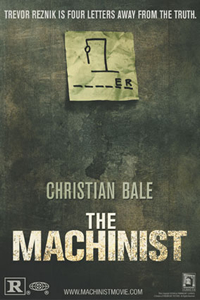
Movie Appraisal: The Machinist (2004)

The Machinist is usually best known as the movie that Christian Bale lost a ton of weight for. It's a little unfair to the movie honestly. Sure, it's quite an accomplishment to go and nearly become anorexic for a role, but I don't think that an actor being skinny is what a movie should be known for. I guess that's my opinion. I mean, directly afterward Christian Bale had to put on a ton of weight to play Batman... so, I guess what I'm saying is that this movie is only ever known (and most people don't even know the name of the film) because Christian Bale had to gain weight to play Batman after losing weight to be in this film.

This is another of my favorite film genre: psychological horror. I guess the genre can be known as psychological thriller too, but I never liked that term. A thriller implies something different to me than horror, and this film seems very much like a horror film to me... there are some scares, and some genuinely uncomfortable parts... it doesn't quite strike me as a thriller in that regard... I guess maybe it's because I think of a thriller as something by Alfred Hitchcock or a movie that is very much like a Hitchcock film or has a Hitchcock kind of plot. This film, from my own definition, is certainly not a thriller, but a horror film. It's a argument of semantics, but, I think, in this case, it's an argument worth making. Actually Jacob's Ladder has the same problem and I'd argue it even more strongly with that movie and some of the horrific scenes therein.

This movie is a great one to watch at this time of year. It just works so well as a psychological film. I mean, if Jacob's Ladder emphasized both horror and a psychological aspect than this one plays things a little differently. The psychological aspect of this film is much stronger, actively screwing with both the main character's perceptions and the audience's as well. It makes this film a bit of a mind screw, which, in my book, is a good thing.

I like this film. I don't love it. It's not one of my favorite of all time, but I do think it is good. I think it is worth watching. The story and acting are excellent, but I do feel the visuals are not as stunning as other movies of this genre such as Jacob's Ladder (Which was made fourteen years before this one.) or 1408. This movie takes a lot from Jacob's Ladder, either intentionally or unintentionally, and those parts make it interesting if not unique. It's main story is quite fascinating and works out to be quite the puzzle.

I actually think I might have liked the film for one particular reason: The main character suffers from a terrible insomnia that has kept him awake for a very long time. It was this insomnia that caused him to lose a ton of weight. I can sympathize. I have pretty bad insomnia (or something like it) and seeing a movie portray insomnia as this movie does... which is accurately... or semi-accurately... makes me happy. It means that there are still some cages of a life that are terrifying even today, in this age of cell phones, laptops, and very little real horror... the horror of being trapped in your own mind... or trapped by your own emotions... or sleeplessness... is one that really strikes me as genuine.

There you go.

Sunday, October 3, 2010

Video Game Assessment: Silent Hill 4: The Room (2004)

A room? Well, rooms are frankly terrifying. This must be the scariest game that there ever was! And a door! Oh, jeez, I'm frankly and seriously terrified and quivering over here! OH BOY.

Silent Hill 4: The Room was released in 2004 as the fourth game in the Silent Hill series. I'm not going to go crazy about this game and say that it's the best video game ever or anything, because it isn't. That being said, it's not a bad game either, and certainly not as bad as people tend to say it is. I think people like to throw hyperboles around all the time. This game is also quite different than the other Silent Hill games, so, of course, people are going to have a lot of issues with it. Now, getting all of that out of the way, I like this game much more than most reviewers tend to, even if it honestly pales in comparison to Silent Hill 2.

In saying that I feel like I should mention that I really never cared for the third game in the series. I never finished it. (EDIT: I did finish it. Not worth it in my opinion.) It was a direct sequel to the first game and I never played the first game... which is probably why I have no attachment to it. As for the other games in the series, the prequel to the first game is short and easy but has a few good moments, and in the fifth game of the series, I became stuck in a particular room and was unable to proceed. The fifth game is also quite bad in my opinion. It doesn't have the polish or the originality of the earlier games in the series. I know there's also Silent Hill: Shattered Memories, but even though I own it, I've never actually played it. I probably will at some point...

So, getting back to the game I'm supposed to be reviewing right now, I like it. It's nowhere near as great as the second game, but I think that this game is a much more experimental game, and I can respect that. And when I say experimental, I really do mean it. It changes a lot of staples of the original three games, having first person perspectives in parts, unkillable enemies that constantly pursue you, and a strange combat system that, although better than the earlier games, is still incredibly awkward. I will say that I find this game having both first and third-person elements really adds to the immersion though, and really let's you sympathize with the protagonist even if he's quiet and a little slow.

Also, just to point it out, the game is not incredibly scary either. I mean, sure, it has its moments, but it is nowhere near as scary as other entries in the series. On its own, its not a bad game, but when compared to Silent Hill 2, it simply isn't as good.

I'm not going to get really in depth with this review because this game's story is so convoluted that you'll never understand it in one playthrough without knowing everything beforehand. The story isn't bad exactly, it's more that it doesn't make that much sense, with as serial killer needing to kill a certain amount of people to do a ritual, all the while being dead himself, a victim of his own ritual. Kind of crazy, huh? Very Japanese in my opinion.

I also like just how much of this game is taken from horror and suspense culture. The main premise of the game is based upon Alfred Hitchcock's Rear Window, which just so happens to be my favorite movie of all time. A man is stuck in his room and can't get out. In that case it was because he had some broken bones and a wheelchair. In this case it's because the protagonist seriously cannot physically get out of his apartment. The real problem is that he shouldn't be stuck. As you can see in the first image, the door is locked from the inside and nothing Henry Townsend, the main character, does will open that door. And that's creepy enough unto itself. How the hell did the door get locked from the inside if it wasn't our pal Henry doing it...?

So, the plot is Henry trying to find out how to get out of the room while simultaneously trying really hard to figure out why he's stuck in his room to begin with. The game goes away from the Silent Hill series staples of mists ad Silent Hill itself, and goes on to focus on outskirts of Silent Hill and a little side story from Silent Hill 2. The idea of being somewhere other than Silent Hill is a big part of Homecoming as well, although I wish they hadn't done that. It did not work as well there as it worked here.

I enjoy this game a lot. I like how it takes elements from so many great icons of horror, like Jacob's Ladder, Hitchcock as mentioned before, and a novel called House of Leaves, which just happens to be my favorite book. It does the references well, making the atmosphere both creepy and a bit of an easter egg unto itself. I like that.

So, this game should be fantastic. Well, I think it is... or at least its imagery is. The plot is... well... it really doesn't matter, which is why I'm barely mentioning it. The characters are pretty terrible too, but they do have their moments, just not many of them. So, the imagery really makes this one... mostly because without that the game would be nowhere near as good... hell, it would probably be pretty terrible actually. With the great imagery though and interesting easter eggs throughout the game, I find this was a memorable experience that I'd love to have again. I suggest anybody who really likes horror imagery to really check out this game.

Anyway, it's 2AM and that's my review.

Edit: Cleaned up this crazy review because I wrote it at 2AM and parts of it made no sense.